
Why Paying More for HDMI Cables Rarely Makes a Difference

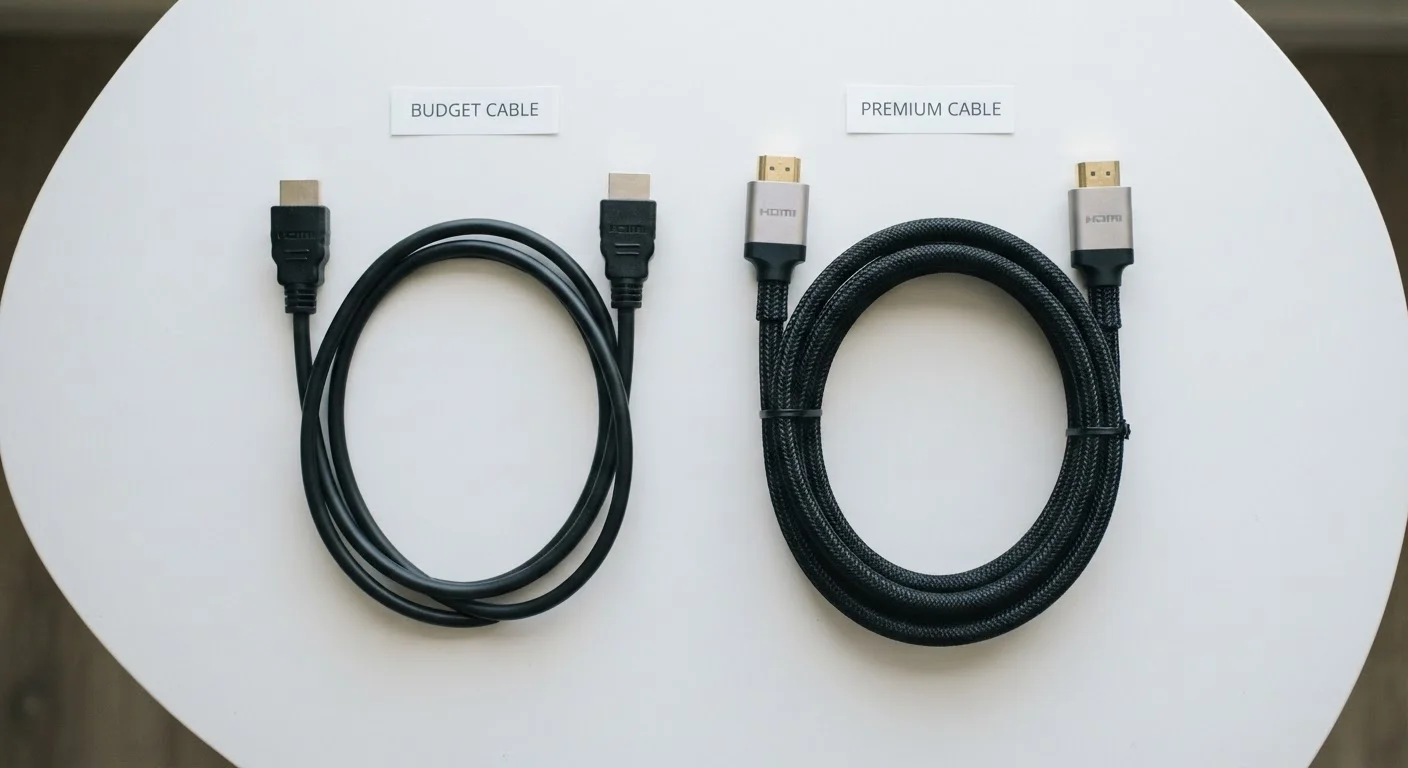
Photo: everyday-trends.com editorial
Key Takeaways
- HDMI is a digital signal: either the data transfers completely or it does not, with no middle ground.
- A certified cable meeting the correct HDMI version spec will perform identically to one costing ten times more.
- Marketing terms like 'gold-plated' and 'oxygen-free' describe materials that do not affect digital signal quality.
- Spending more on a cable makes sense only in very specific situations, such as very long cable runs.
- The money saved on cables is better applied to the display or source device itself.
How HDMI actually works
HDMI carries audio and video as digital data, not an analog wave that degrades as it travels. Each frame of picture information is transmitted as a stream of ones and zeros. The receiving device either reconstructs that data correctly or it does not. There is no state between a perfect picture and a failed connection where a cheaper cable produces a slightly worse image.
This is fundamentally different from older analog cables such as component or composite video, where cable quality genuinely affected signal integrity. With HDMI, the cable's job is to pass a threshold, and any cable meeting the relevant HDMI specification clears that threshold by design.
For a broader look at which TV specifications actually affect what you see on screen, see our guide to resolution and refresh rate.
Common myths, corrected
Retailers and cable manufacturers have built a substantial business on the assumption that consumers will apply analog-era thinking to a digital standard. The myths below are among the most persistent.
Myth
Gold-plated connectors improve picture and sound quality.
Fact
Gold plating resists corrosion over time but has no effect on how digital data is transmitted.
Digital signal transmission does not vary with connector material the way analog circuits can. Gold plating prevents oxidation on the metal contact points, which could theoretically cause a connection to fail after many years of exposure. It does not make the signal 'cleaner' or sharper. On a cable that stays connected behind a television, the difference between gold and standard plating is effectively irrelevant during the product's practical lifespan.
Myth
Oxygen-free copper wire produces a better, purer signal.
Fact
Oxygen-free copper is a manufacturing quality marker, not a performance advantage in HDMI applications.
Oxygen-free copper (OFC) reduces microscopic voids in the wire, which can matter for high-frequency analog audio cables. In a digital HDMI context, the signal is binary data moving at high speed over a short distance. The wire composition does not change whether that data arrives intact. Cables marketed on OFC content are trading on an analog-era reputation that does not carry over to digital transmission.
Myth
A more expensive cable will display a noticeably sharper or more vivid picture.
Fact
Picture quality from an HDMI cable is determined entirely by whether the signal passes at the required bandwidth, which any correctly certified cable achieves.
Because HDMI carries digital data, the display receives either the full, correct frame or a corrupted/dropped signal. A $6 certified cable and a $60 cable with the same version rating will produce an indistinguishable image. If a cheap cable fails to carry the signal at all, symptoms will be obvious: flickering, a blank screen, or audio dropouts. A visibly degraded but otherwise working picture is not a symptom of HDMI cable quality.
Myth
Thicker cables always perform better.
Fact
Cable thickness affects durability and flexibility, not signal quality over typical home distances.
A thicker cable jacket protects the internal wires from physical stress and bending damage. For a cable that will be routed repeatedly or handled frequently, that durability is worth having. For a cable running a few feet between a console and a TV, thickness adds cost and stiffness with no performance return. Signal quality over distances under 15 to 20 feet is determined by the cable's version certification, not its diameter.
When cable quality actually matters
There are genuine situations where cable construction deserves more attention. Cable runs longer than roughly 25 feet can experience signal loss, and in those cases a higher-quality or active cable (one with a built-in signal booster) is worth considering. Cables routed through walls or conduit benefit from thicker shielding, not because of picture quality but because of physical durability.
The other factor is HDMI version compatibility. A cable must support the correct version for the features you need. Sending 4K HDR at 120Hz requires a cable rated for 48Gbps bandwidth (labeled as Ultra High Speed). Using an older cable that cannot carry that bandwidth will cause problems. However, any cable with the appropriate certification will work, regardless of price within that category.
Beware of uncertified 'HDMI 2.1' cables
For context on how your source device fits into the picture, our comparison of streaming sticks and smart TV apps covers what hardware actually drives performance.
What the price difference actually buys
Higher-priced cables often have thicker outer jackets, metal-bodied connectors, and tighter braiding. These attributes affect how a cable feels and how long it lasts under repeated bending, not how it transmits data. If a cable will be plugged in permanently behind a TV and never touched, those durability features provide no practical value.
Gold plating on connectors is a real feature, but its purpose is corrosion resistance over many years, not signal quality. A connector that corrodes could eventually cause connection problems, but standard tin or nickel plating on a cable that stays plugged in presents no meaningful risk over a typical product lifespan.
The practical conclusion is that the version certification on the packaging matters far more than the price. Check that the cable is certified for the bandwidth your setup requires, and allocate the rest of that budget toward the device on either end of the cable.
The content provided on our blog site traverses numerous categories, offering readers valuable and practical information. Readers can use the editorial team’s research and data to gain more insights into their topics of interest. However, they are requested not to treat the articles as conclusive. The website team cannot be held responsible for differences in data or inaccuracies found across other platforms. Please also note that the site might also miss out on various schemes and offers available that the readers may find more beneficial than the ones we cover.