
What 'R-Value' Actually Means for Your Home's Insulation

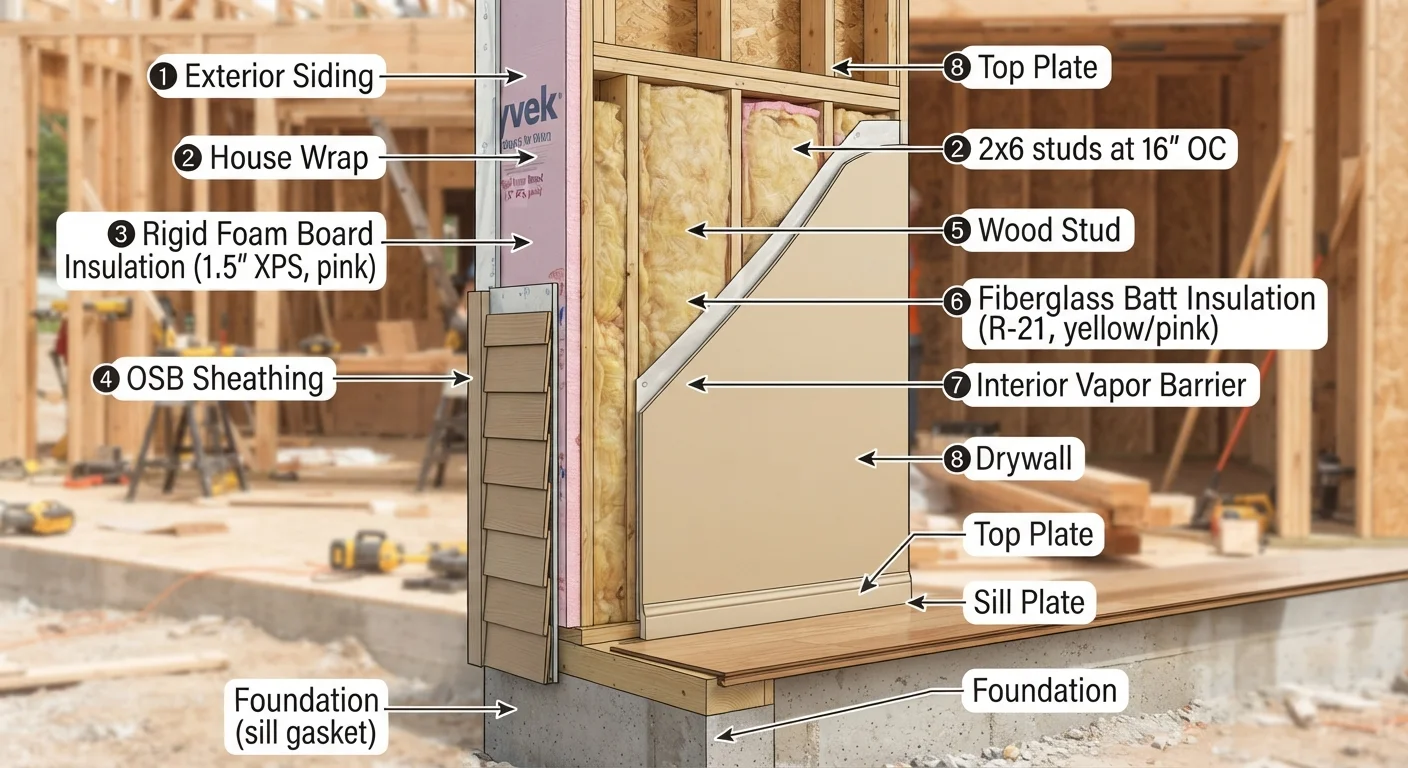
Photo: everyday-trends.com editorial
Key Takeaways
- R-value measures resistance to heat flow; higher numbers mean better insulating performance.
- The right R-value for your home depends on your climate zone and where the insulation is installed.
- Total R-value in a wall or attic assembly is the sum of all material layers combined.
- Air leaks reduce the real-world effectiveness of insulation regardless of its rated R-value.
- Building codes set minimum R-value requirements that vary by US region and installation location.
What R-value actually measures
Heat moves through building materials constantly. In winter, warmth generated inside your home tries to escape through walls, ceilings, and floors. In summer, outdoor heat tries to push inward. R-value measures how much a material resists that movement.
The "R" stands for thermal resistance. When insulation carries an R-19 rating, that number tells you how effectively 1 square foot of that material, at the installed thickness, slows heat transfer. A wall rated R-19 resists heat flow roughly twice as well as one rated R-10.
R-values are additive. If your wall has 1 inch of rigid foam board on the exterior (R-5) and fiberglass batts in the cavity (R-13), the combined assembly is approximately R-18. This stacking principle is why contractors sometimes layer different insulation types to hit a target number without requiring one very thick product.
R-value is not the same as U-factor
Why the number on the bag does not tell the whole story
Manufacturers test insulation under controlled laboratory conditions. Real-world performance can differ because of three factors: installation quality, air leaks, and moisture.
Compressed fiberglass loses R-value. If a batt rated R-19 is squeezed into a 2x4 wall cavity designed for R-13, it does not perform at R-19; the compression reduces its effectiveness. Similarly, gaps at the edges of batts create thermal shortcuts that bypass the insulation entirely.
Air leakage is a separate issue from insulation. R-value measures resistance to conductive heat flow through a solid material, not resistance to air moving through gaps in your building envelope. A well-insulated wall with an unsealed electrical outlet can lose significant heat through convective air movement. Sealing air leaks before adding insulation is generally the more cost-effective first step.
R-38 to R-60
Recommended attic R-value for most US climate zones
According to the US Department of Energy's insulation recommendations by climate zone.
~15%
Share of home heat loss through the ceiling and attic
The DOE estimates that ceilings and attics account for a notable portion of heat loss in typical under-insulated American homes.
R-6 to R-7
R-value per inch of closed-cell spray foam
Closed-cell spray foam has one of the highest R-values per inch of any commonly available residential insulation material.
How climate zones shape the right R-value for your home
The US Department of Energy divides the country into eight climate zones, from the warm Gulf Coast (Zone 1) to the far northern states and Alaska (Zone 7 and above). Each zone has recommended R-values for different parts of the home: attic, walls, floors, and crawl spaces.
A home in Minnesota needs significantly more attic insulation than a home in Florida, because the temperature difference between inside and outside is larger for more months of the year. In cold climates, heat loss through an under-insulated attic is one of the largest contributors to high winter energy costs.
You can find your climate zone using the DOE's online map and then check its corresponding insulation recommendations. Local building codes also set minimum R-values for new construction and, in some cases, for renovation projects that require permits. Checking both the DOE guidance and your local code gives you a practical target range.
Comparing insulation types by R-value per inch
Different materials achieve different R-values for the same thickness. This matters most when space is limited, such as in finished walls or low-slope roofs where you cannot simply add more depth.
- Fiberglass batts typically achieve R-2.9 to R-3.8 per inch, depending on density and product type.
- Blown-in cellulose runs approximately R-3.2 to R-3.8 per inch and fills irregular spaces more completely than batts.
- Open-cell spray foam is around R-3.5 to R-3.9 per inch.
- Closed-cell spray foam reaches R-6 to R-7 per inch, the highest of common residential options.
- Rigid foam boards (polyisocyanurate, expanded polystyrene, or extruded polystyrene) range from R-3.8 to R-6.5 per inch depending on type.
When you have space for depth, batts and blown-in materials are often more economical to install. When space is tight, higher-R-per-inch options may justify their added cost.
Using R-value when evaluating your home's insulation
If you want to assess what you currently have, a home energy auditor can measure existing insulation depth and material type, then calculate the approximate R-value of your current assemblies. Some utility companies offer free or subsidized audits; check with your local utility for programs in your area.
For a rough self-assessment in an unfinished attic, you can measure the depth of existing insulation with a ruler. Most insulation products include a chart on the bag showing R-value by installed depth. Compare that figure to the DOE recommendation for your climate zone to see whether an upgrade is worth pursuing.
When budgeting for insulation work, prioritize the location with the largest gap between current and recommended R-value. Attics are often the most accessible and cost-effective place to add insulation in existing homes because the space is open and labor is straightforward compared to wall cavities.
This article is for general informational and educational purposes only. Insulation work involving electrical, structural, or moisture-related concerns should be evaluated by a licensed contractor. Always verify local permit and code requirements before beginning any home improvement project.
Frequently Asked Questions
The content provided on our blog site traverses numerous categories, offering readers valuable and practical information. Readers can use the editorial team’s research and data to gain more insights into their topics of interest. However, they are requested not to treat the articles as conclusive. The website team cannot be held responsible for differences in data or inaccuracies found across other platforms. Please also note that the site might also miss out on various schemes and offers available that the readers may find more beneficial than the ones we cover.