
Before You Sign the Lease: Understanding Auto Lease Terms for First-Timers

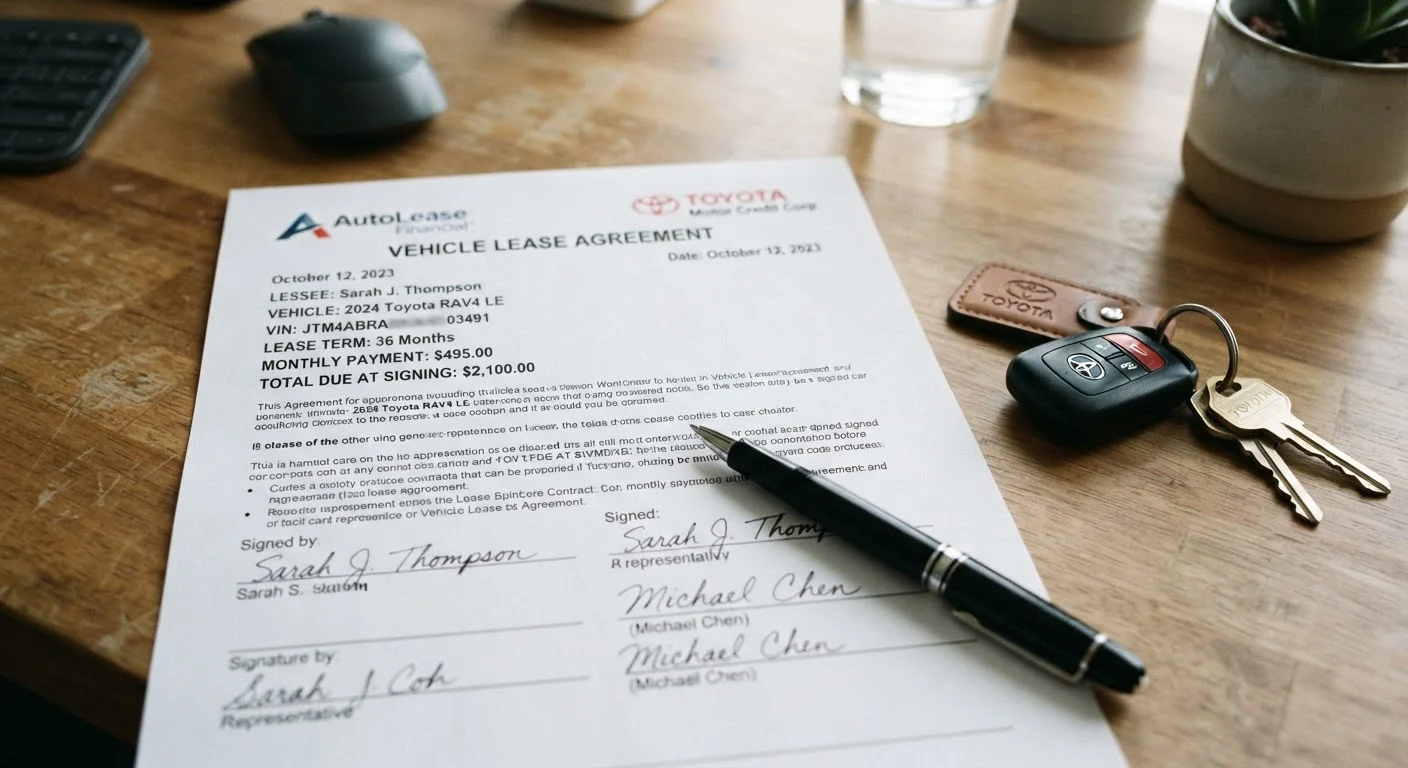
Photo: everyday-trends.com editorial
Key Takeaways
- A lease payment is based on depreciation, not the full vehicle price.
- Money factor is the lease equivalent of an interest rate, and it is negotiable.
- Exceeding your mileage allowance triggers per-mile overage fees at lease end.
- Residual value is the projected worth of the vehicle at lease end, set by the lender.
- At lease end you typically have three options: return, buy, or re-lease.
- Leasing rarely builds equity, which matters for long-term household finances.
What a lease actually is
A car lease is a long-term rental agreement, typically 24 to 48 months. You pay to use a vehicle for a set period, then return it (or buy it) at the end. You do not own the car at any point during the term, and the monthly payment does not build toward ownership unless you exercise a purchase option later.
The leasing company (usually the automaker's finance arm or a bank) owns the vehicle throughout the term. This distinction matters because the contract is structured around the vehicle's expected depreciation, not its full price. Understanding how vehicle depreciation works is useful background before you commit to a lease, since it directly shapes what you pay each month.
Capitalized cost
The agreed price of the vehicle used as the starting point for lease calculations. Negotiating it lower reduces your monthly payment.
Residual value
The lender's estimate of what the vehicle will be worth when the lease ends. A higher residual means a lower monthly payment.
Money factor
The finance charge in a lease, written as a small decimal. Multiply it by 2,400 to get a rough annual percentage rate equivalent.
Mileage cap
The maximum number of miles per year allowed under the lease. Driving beyond this limit triggers per-mile overage charges at return.
Disposition fee
A charge the lender applies at lease end to cover the cost of reselling the returned vehicle. Usually waived if you buy the car.
Gap coverage
A protection product that pays the difference between what your auto insurance pays on a totaled vehicle and what you still owe under the lease.
The terms that determine your monthly payment
Three numbers control almost every lease payment: the capitalized cost, the residual value, and the money factor.
- Capitalized cost is the agreed vehicle price used in the lease calculation. Negotiating this down reduces your payment, just as it would in a purchase.
- Residual value is the lender's projected worth of the vehicle at lease end. You finance the gap between the capitalized cost and the residual value, so a higher residual value means a lower payment.
- Money factor is the lease finance charge, expressed as a small decimal. Multiply it by 2,400 to approximate an equivalent annual percentage rate. A money factor of 0.00125 is roughly 3% APR.
Your monthly payment covers that depreciation gap plus the finance charge, divided across the term. Taxes and fees are added on top. Because you are only financing depreciation, lease payments are often lower than loan payments on the same vehicle. For a fuller look at how loan-based financing compares, see how auto loan interest is calculated.
Check the money factor before you agree
Mileage caps and wear-and-tear rules
Lease contracts set an annual mileage allowance, typically 10,000, 12,000, or 15,000 miles per year. Every mile driven beyond that limit is charged at a per-mile rate stated in the contract, commonly $0.15 to $0.30 per mile. On a 36-month lease with a 12,000-mile annual cap, the total allowance is 36,000 miles. Going 5,000 miles over at $0.25 per mile costs $1,250 at return.
Wear-and-tear provisions define what the lender considers normal versus excessive damage. Scuffs on a bumper may be acceptable; a dent or a torn seat likely is not. Many dealers offer prepaid excess-wear coverage, though whether it is worth the cost depends on how carefully the vehicle is used and what the contract's specific thresholds are.
Families with long commutes or frequent road trips should calculate their realistic annual mileage before signing. If your household consistently drives more than the standard caps allow, leasing tends to cost more than buying over the same period.
End-of-lease options and fees to expect
When the term ends, you generally have three paths. First, you can return the vehicle and walk away, provided you have stayed within the mileage cap and avoided excessive wear. Second, you can purchase the vehicle at the residual value stated in the contract, which may be advantageous if the car is worth more on the open market than the residual. Third, you can re-lease a new vehicle under a fresh agreement.
Fees to budget for at return include a disposition fee (typically $300 to $500), which covers the lender's cost of reselling the vehicle. If you choose to purchase the car, the disposition fee is usually waived. Any mileage overage and wear-and-tear charges are billed at the same time.
One charge many first-timers overlook is the gap between what insurance pays if the car is totaled and what you still owe on the lease. Gap coverage (Guaranteed Asset Protection) addresses this. Check whether the lease already includes it or whether you need to add it through your insurer.
Leasing versus buying: a straightforward comparison
Leasing fits households that prefer lower monthly payments, want a newer vehicle on a regular cycle, and drive predictable annual mileage within standard caps. Buying fits households that want to build equity, drive high mileage, or keep a vehicle well past the point where monthly payments end.
The core trade-off is this: leasing typically costs less per month but produces no asset at the end of the term. Buying costs more per month in most cases, but once the loan is paid off, the vehicle has value that can be applied toward a future purchase. For families thinking about the long-term cost of renting versus owning in other areas of their finances, the same equity logic applies here.
Neither arrangement is universally better. The right choice depends on how many miles your household drives, how long you typically keep vehicles, and how your monthly budget is structured. Reading every clause before signing, including mileage limits, wear terms, early-termination fees, and gap coverage details, is the most direct way to avoid surprises.
This article is for general informational and educational purposes only. It does not constitute financial, legal, or consumer advice tailored to your individual situation. Consult a qualified financial adviser or legal professional before making vehicle financing decisions.
Frequently Asked Questions
The content provided on our blog site traverses numerous categories, offering readers valuable and practical information. Readers can use the editorial team’s research and data to gain more insights into their topics of interest. However, they are requested not to treat the articles as conclusive. The website team cannot be held responsible for differences in data or inaccuracies found across other platforms. Please also note that the site might also miss out on various schemes and offers available that the readers may find more beneficial than the ones we cover.